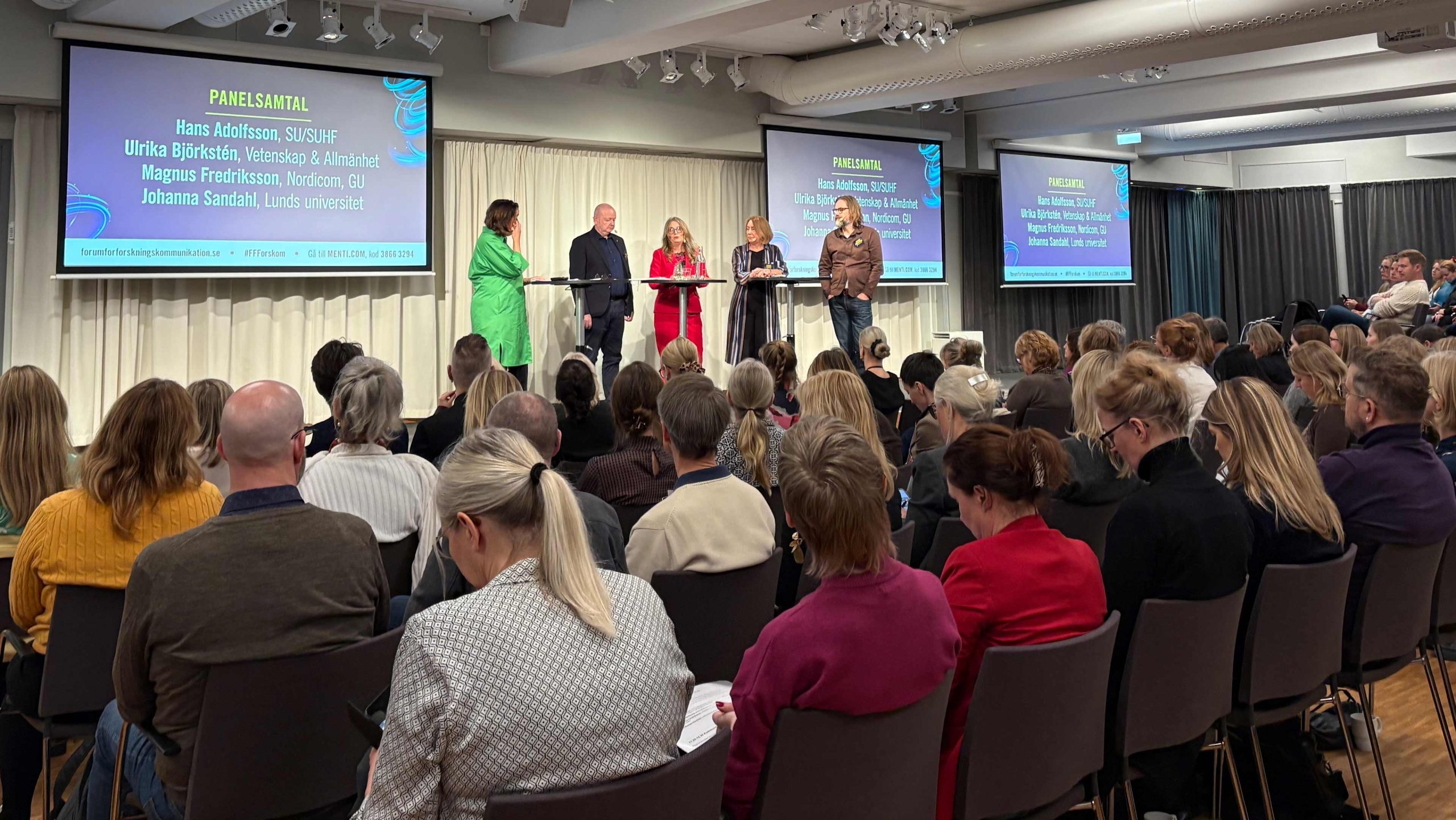
Nearly 300 professionals in science communication gathered in Stockholm on 19 November for this year’s Forum for Science Communication (FFF). Organised annually by Public & Science with the support of seven partners (funders and universities), FFF is the largest Nordic conference for everyone working with, or interested in, communicating science. The conference theme this year – trust – set the tone for a day of keynote presentations, panel discussions and networking.
Understanding trust
The morning programme focused on understanding trust: what it is, who has it, and how it can be built – or broken. Henrik Ekengren Oscarsson, Professor of Political Science at the University of Gothenburg, unpacked the concept and examined how trust in public institutions, government and politics has changed over time in Sweden.
“Trust is a forecasting instrument – it shows how well something lives up to our expectations. Hard to earn, but easy to lose,” he noted.
Ulrika Björkstén, Secretary-General of Public & Science then presented fresh results from the annual Swedish Science Barometer, confirming that public confidence in research and researchers in Sweden remains high.
This was followed by a panel discussion featuring Hans Adolfsson, Ulrika Björkstén, Magnus Fredriksson and Johanna Sandahl, who reflected on the role of the science communicator today. The debate raised questions about possible tensions between communicating open scientific processes on one hand, and promoting institutions or individual achievements on the other.
Communication and relationship-building
The spotlight then turned to practical examples of outreach and engagement.
Ana Godinho, Head of Communications and Engagement at ESS (the European Spallation Source), shared insights from Europe’s major research facilities – ESS and CERN – showing how outreach activities, such as open days and exhibitions, help build trust in their researchers, their research, the organisations and science. She stressed the importance of being strategic as well as being authentic. Ana’s presentation is available to watch in English below.
Catherine Fulgencio, social media editor at the popular science magazine Folk och Framsteg, also offered hands-on advice for reaching the “scrolling generation” on TikTok and Snapchat: a compelling first visual impression, a strong opening line – and posting consistently.
Celebrating excellence: Hall of Fame 2025
For the second year, the Hall of Fame award was awarded, which honours outstanding contributions to science communication. This year’s winners were Annica Hulth and Åsa Malmberg, recognised for creating and producing Forskarpodden (“The Researcher Podcast”), which for ten years has opened doors to research at Uppsala University for a broad public audience.
“Forskarpodden is one of the most enjoyable parts of our job,” they said on stage. “The challenge is to make content accessible – asking questions in a way that connects with people.”
Researchers’ Grand Prix winner takes to the stage
The morning programme ended with a performance by Carl Öhman, from Uppsala University, who had been crowned winner of Sweden’s national science communication competition Researchers’ Grand Prix the day before. In a rapid and engaging four-minute presentation, he explored what happens to our digital remains when we die – and who controls them.
“The internet is becoming the world’s largest graveyard,” he warned. “Who owns it is a question of power.”
Three strands: policy, audiences and disinformation
After lunch, participants chose between three parallel sessions:
- Reaching out and breaking through – from young urban audiences to older groups in rural areas
- Research and politics – how do we reach decision-makers?
- Science communication as a defence against disinformation
The sessions provided practical examples of how to connect with different communities, insights into how policymakers engage with research, and reminders of why it is vital not to stay silent in the face of falsehoods. The day wrapped up with a joint reflection from all three strands.
The Forum for Science Communication 2025 was organised by the non-profit organisation Public & Science Sweden (Vetenskap & Allmänhet) together with the research councils Forte, the Swedish Research Council and Vinnova, as well as Knut and Alice Wallenberg Foundation, the Knowledge Foundation, the Riksbankens Jubileumsfond (RJ), and the University Alliance Stockholm Trio.
The aim of the conference is to provide participants with inspiration, new knowledge about tools and methods for science communication and the opportunity to network and exchange experiences with others. The conference is mainly held in Swedish, but often with keynote speeches in English.